Publications
-
Collective dynamics of macroscopic photoactive matter under alternating excitation patterns
S. Lévay, A. Katona, R. Cruz Hidalgo, I. Zuriguel
Phys. Rev. E, 113, 055423 (2026).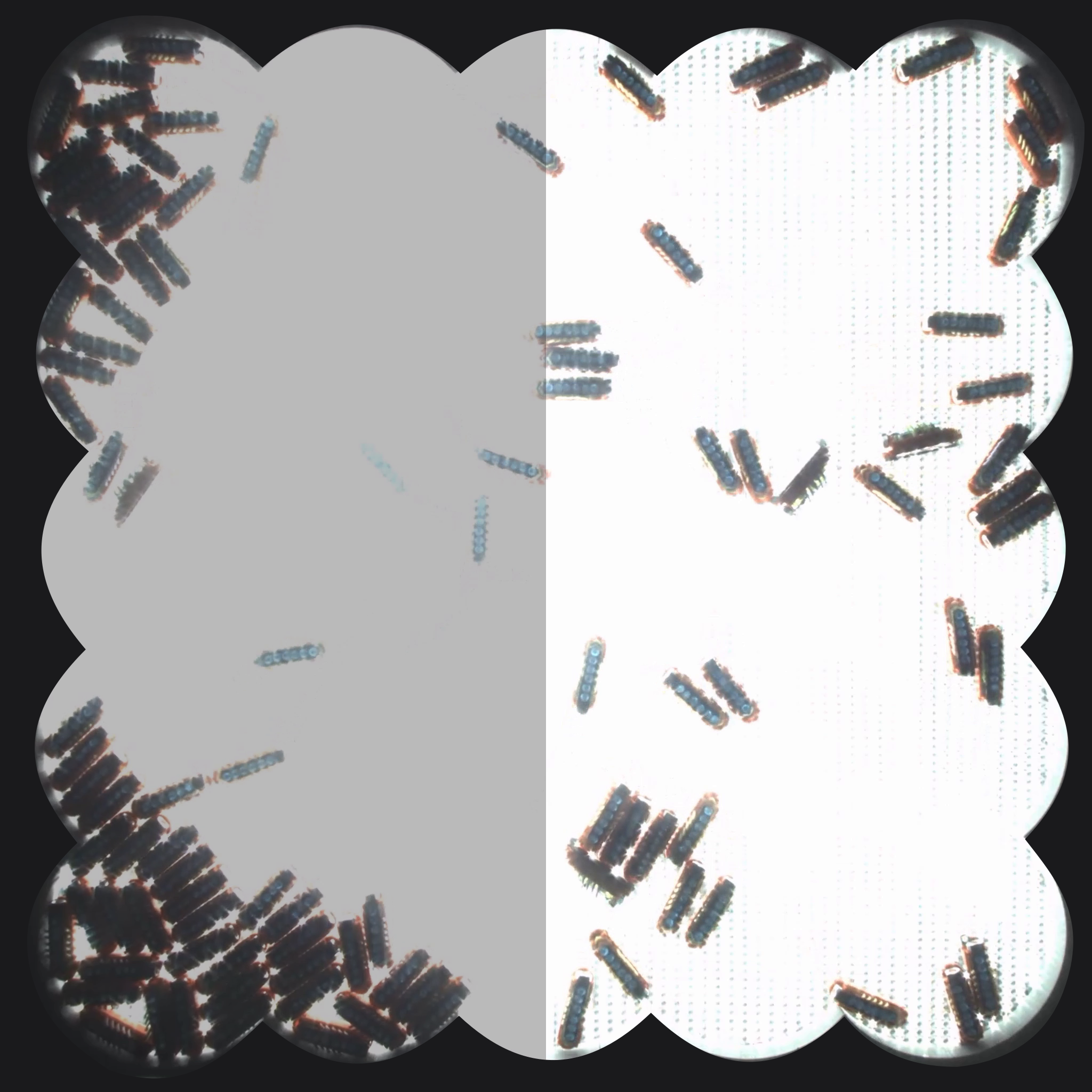 Self-propelled particles often gather into dense clusters, similar to how crowds form in busy spaces. This study shows that their collective motion can be controlled by periodically switching the particles’ activity. The particles move faster in brighter regions and slower in darker ones, causing them to accumulate where motion is reduced. When the light conditions change slowly, the clusters repeatedly reorganize and follow the external environment. But when the switching becomes too rapid, the system can no longer adapt and becomes trapped in stable structures. By combining experiments and theory, the study reveals how collective motion competes with changing environmental conditions. The results provide a simple and highly controllable platform for studying active matter and could help guide the design of future active materials and transport systems.
-
Collective behavior of macroscopic photoactive particles: An experimental study
S. Lévay, A. Katona, H. Löwen, R. C. Hidalgo, and Iker Zuriguel EPJ Web Conf., 340, 12003 (2025).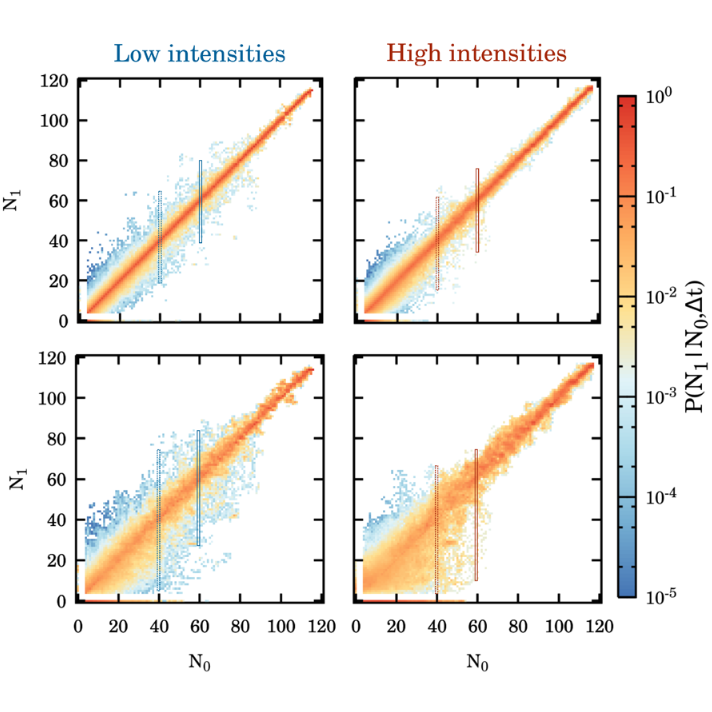 We experimentally investigate the collective behavior of an active granular system in which the activity of the macroscopic self-propelled agents is controlled by light intensity. This allows us to test the system response to the agents excitation by simply changing the illumination intensity. We explore a broad range of excitation levels and population sizes, discovering the existence of a transition from stable cluster development at low excitation intensities and large population sizes to unstable clustering when the light intensity is high and the population is small. Through an extensive analysis of cluster dynamics, we have constructed a phase diagram that illustrates this transition, providing insights into the mechanisms governing collective behavior in active granular matter.
-
Cluster dynamics in macroscopic photoactive particles
S. Lévay, A. Katona, H. Löwen, R. Cruz Hidalgo, I. Zuriguel
Phys. Rev. Lett., 135, 098301 (2025).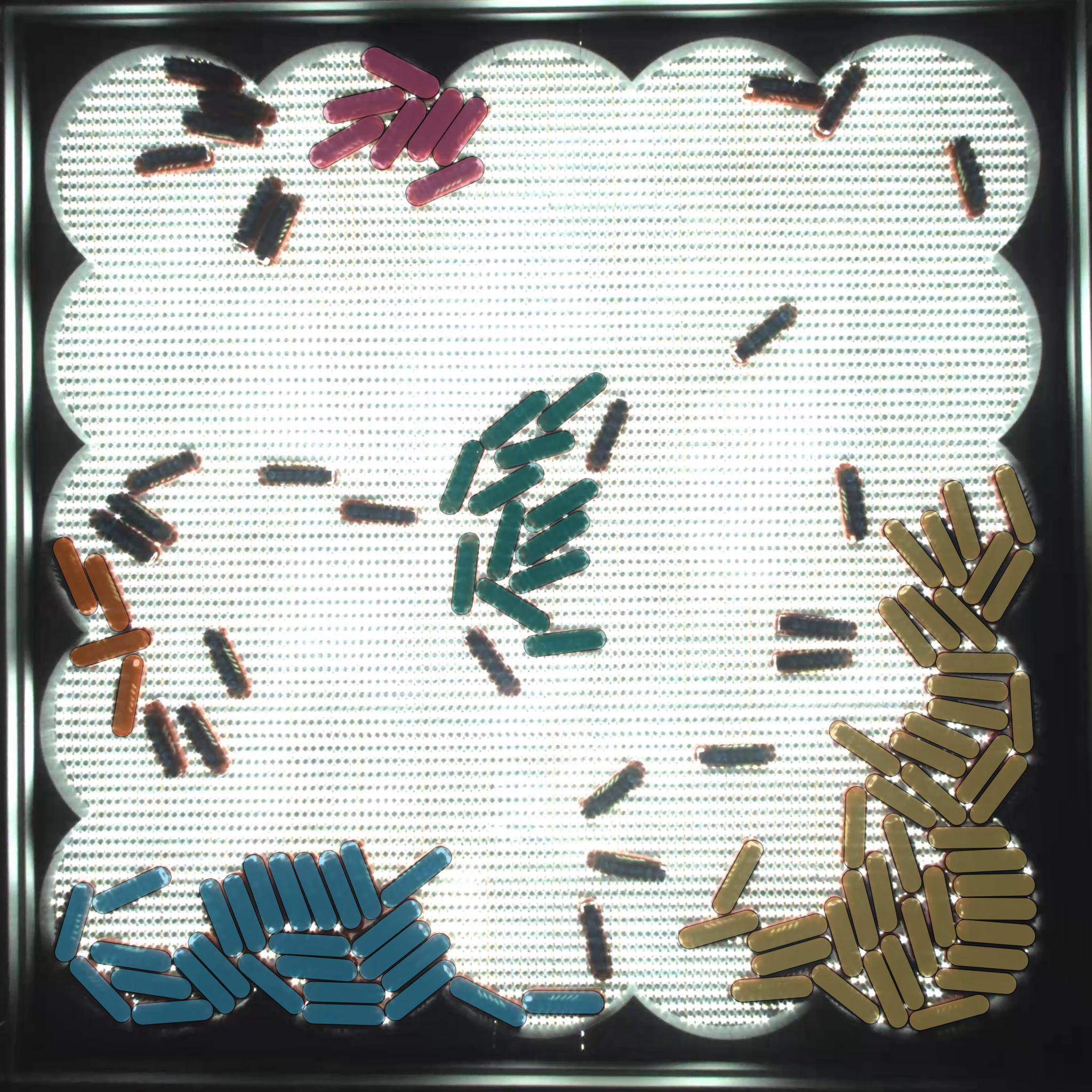 We present an experimental study on the collective behavior of macroscopic self-propelled particles that are externally excited by light. This property allows testing the system response to the excitation intensity in a very versatile manner. We discover that for low excitation intensities, clustering at the boundaries is always present, even when this is prevented by implementing flower-shaped confining walls. For high excitation intensities, however, clusters are dissolved more or less easily depending on their size. Then, a thorough analysis of the cluster dynamics allows us to depict a phase diagram depending on the number of agents in the arena and the excitation intensity. To explain this, we introduce a simple kinetic model where cluster evolution is governed by a balance between adsorption and desorption processes. Interestingly, this simple model is able to reproduce the phase space observed experimentally.
-
Transverse vortices induced by modulated granular shear flows of elongated particles
S. Lévay, P. Claudin, E. Somfai, T. Börzsönyi
Phys. Rev. E, 112, 015402 (2025).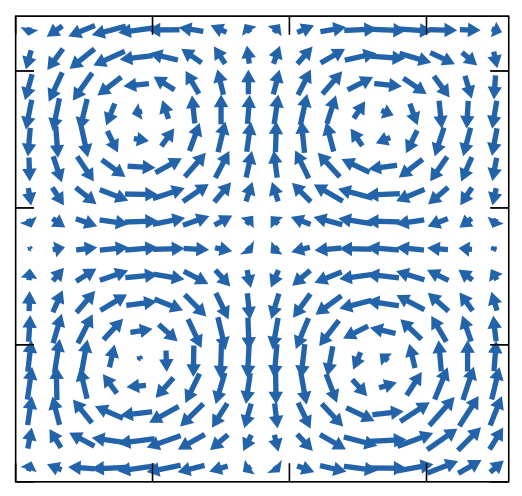 We have performed DEM simulations of elongated grains in a shear cell for various particle aspect ratios and contact frictions, with an additional heterogeneous force perturbation in the flow direction. For a perturbation in the form of a single Fourier mode, we show that the response of the system consists of transverse secondary flows that average onto a pattern of four vortices. We have also theoretically studied this phenomenon by generalizing the granular rheology μ(I) to the case of elongated grains and computing the linear response to such a perturbation. Even if the agreement between theory and simulations remains qualitative only, we can reproduce and understand the inversion of the vortex pattern when the cell aspect ratio is increased from a vertically to a horizontally elongated cell shape, emphasizing the key role of the second normal stress difference as well as the cell geometry.
-
Lacunarity as a quantitative measure of mixing—a micro-CT analysis-based case study on granular materials
L. Vásárhelyi, D. Sebők, I. Szenti, Á. Tóth, S. Lévay, R. Vajtai, Z. Kónya, Á. Kukovecz
Oxford Open Materials Science, 3, 1 (2023).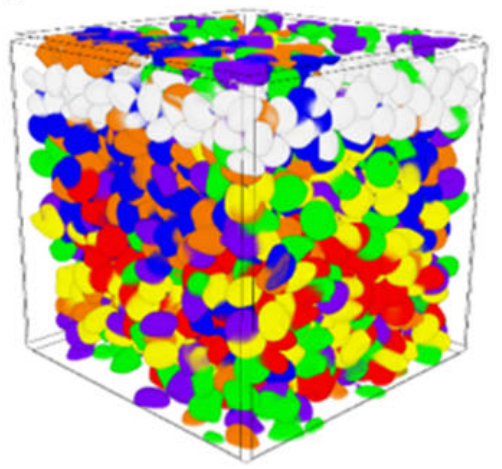 In practically every industry, mixing is a fundamental process, yet its 3D analysis is scarce in the literature. High-resolution computed tomography (micro-CT) is the perfect X-ray imaging tool to investigate the mixing of granular materials. Other than qualitative analysis, 3D micro-CT images provide an opportunity for quantitative analysis, which is of utmost importance, in terms of efficiency (time and budget) and environmental impact of the mixing process. In this work, lacunarity is proposed as a measure of mixing. By the lacunarity calculation on the repeated micro-CT measurements, a temporal description of the mixing can be given in three dimensions. As opposed to traditional mixing indices, the lacunarity curve provides additional information regarding the spatial distribution of the grains. Discrete element method simulations were also performed and showed similar results to the experiments.
-
Interacting jammed granular systems
S. Lévay, D. Fischer, R. Stannarius, E. Somfai, T. Börzsönyi, L. Brendel, and J. Török
Phys. Rev. E, 103, 042901 (2021).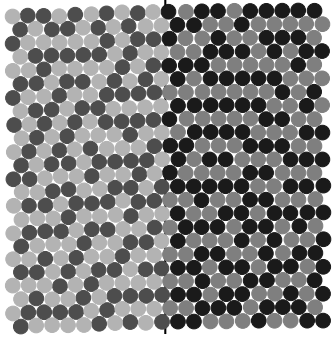 We have shown, that a 2+ε-dimensional geometrically frustrated confined system (introduced here) can be described by the Edwards ensemble, the partition function can be formulated analytically, and the observables can be calculated analytically. By connecting two well-defined systems we have shown, that the case of coupled subsystems can only be described by the Edwards ensemble if the stress equilibrium is taken into account at the microstate level and the partition function of the full system is calculated.
-
Flow in an hourglass: particle friction and stiffness matter
T. Pongó, V. Stiga, J. Török, S. Lévay, B. Szabó, R. Stannarius, R. Cruz Hidalgo, and T. Börzsönyi
New Journal of Physics, 23, 023001 (2021).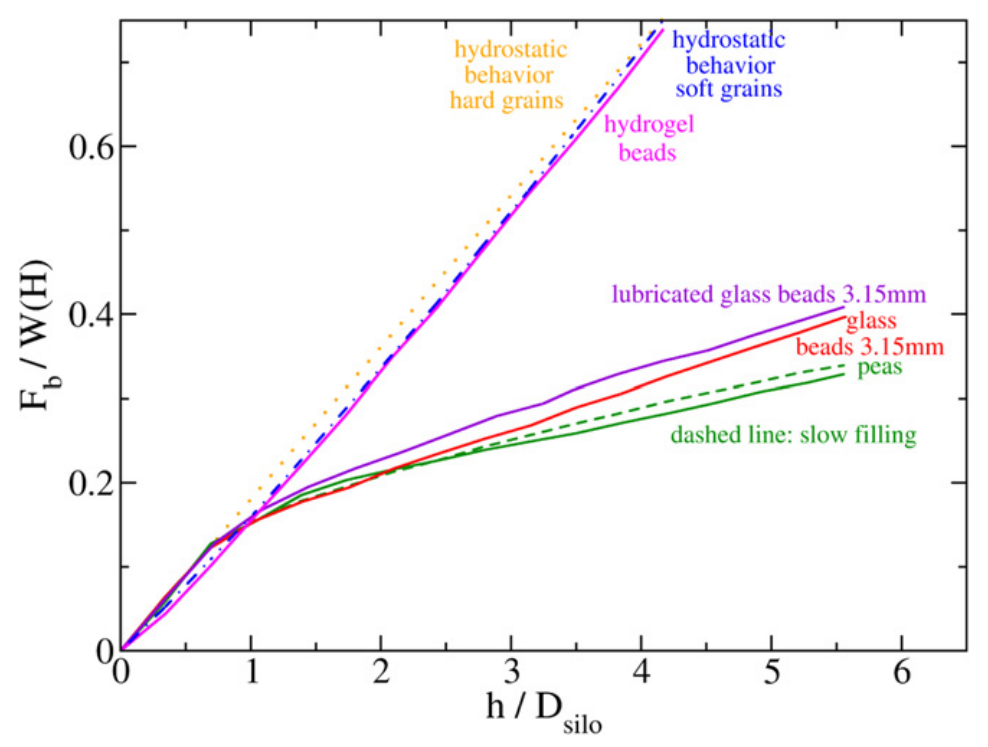 We have studied the effect of particle stiffness and coefficient of friction on the flow behavior of spherical particles in a silo by means of DEM simulations and experiments. We have shown, that the interparticle friction has a much stronger effect for soft grains than for hard grains.
-
Frustrated packing in a granular system under geometrical confinement
S. Lévay, D. Fischer, R. Stannarius, B. Szabó, T. Börzsönyi, and J. Török
Soft Matter, 14, 396-404 (2018).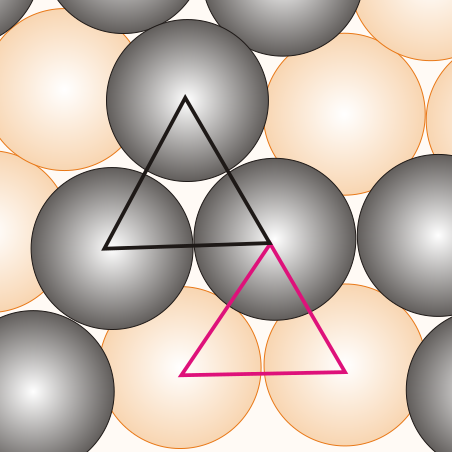 We have shown by means of DEM simulations and experiments that the ordering of monodisperse spherical particles during shaking in a narrow, 2+ε-dimensional cuboid cell is driven by the area change of local 7-particle configurations and the antiferromagnetic vertical alignment. We have shown that the ground state of the system is never reached due to the formation of perfectly ordered incompatible domains. Our Monte Carlo simulations revealed that in order to reach the ground state further, unfavourable events with very small probability would be needed.
-
Arching in three dimensional clogging
J. Török, S. Lévay, B. Szabó, E. Somfai, S. Wegner, R. Stannarius, and T. Börzsönyi EPJ Web Conf., 140, 03076 (2017).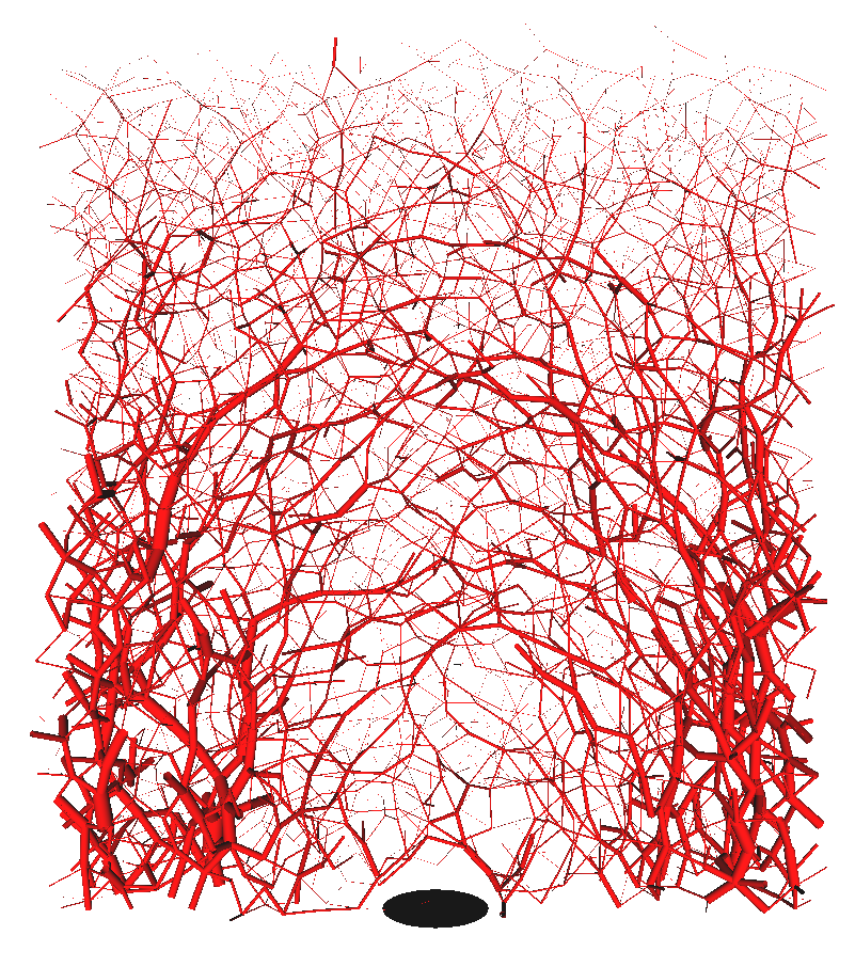 We have studied three-dimensional clogging by means of DEM simulations with spherical and elongated particles. We have shown, that the clogged structure above the orifice is a primary, two-dimensional arch supported by secondary arches, and the interparticle force network of the system shows an onion-like layered structure.
-
Multiple shear bands in granular materials
S. Lévay and J. Török EPJ Web Conf., 140, 03084 (2017).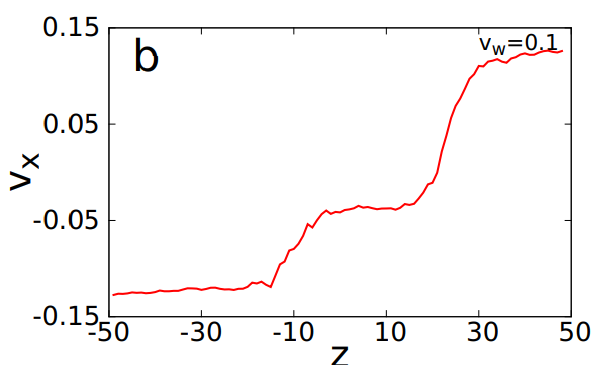 We studied the transition regime from quasi-static to dynamic shear by means of DEM simulations and a mesoscopic model. We have shown that at a moderate shear rate multiple shear bands appear which eventually appear as a continuous shear profile for large shear rates. We also have shown how the long range order present in the quasi-static regime is gradually destroyed by the presence of multiple shear bands.
-
Segregation of granular mixtures in a spherical tumbler
T. Finger, F. v. Rüling, S. Lévay, B. Szabó, T. Börzsönyi, and R. Stannarius Phys. Rev. E, 93, 032903 (2016).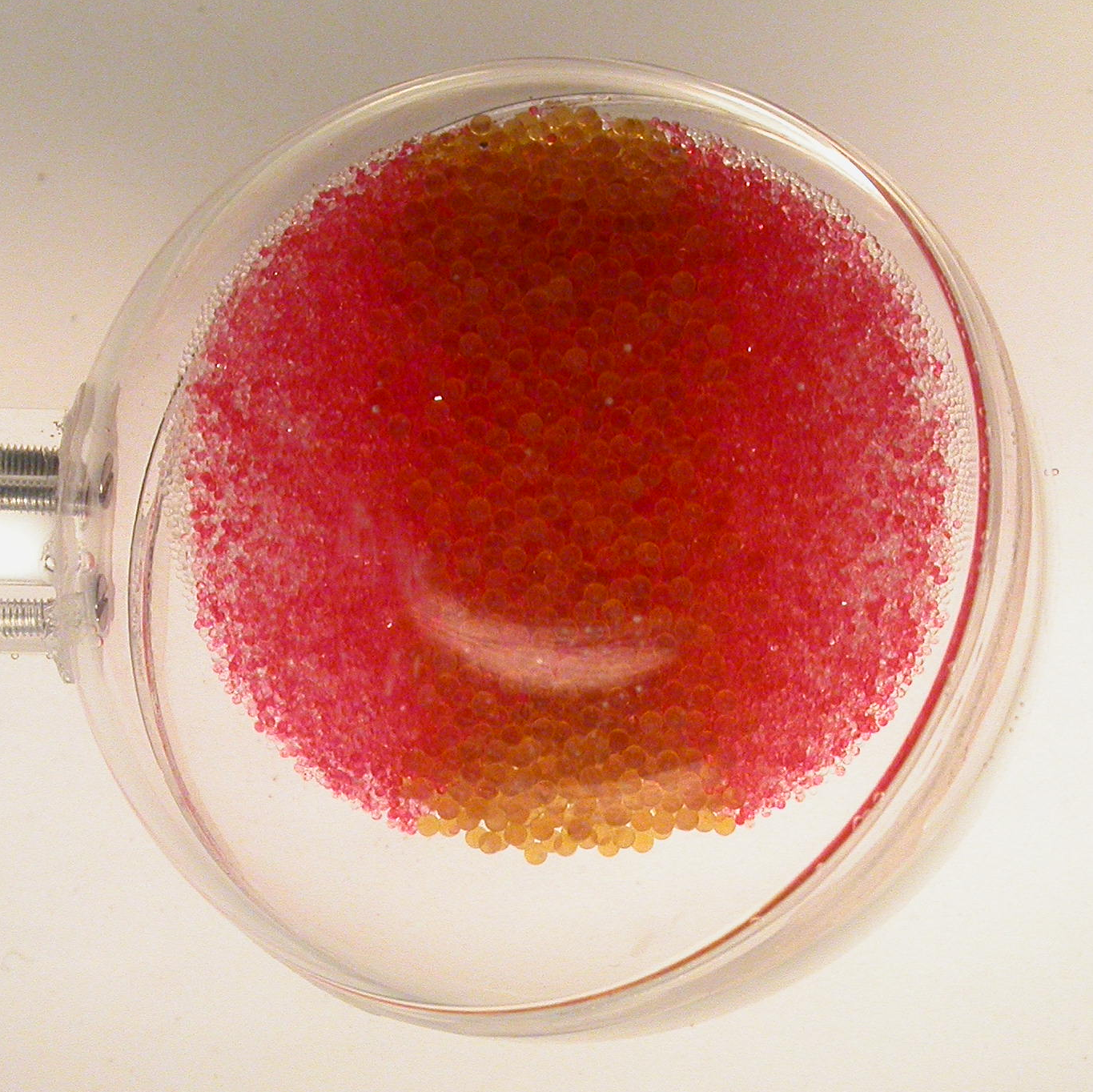 In this study we described the axial segregation of bidisperse granular mixtures of glass beads in a spherical container, rotating about its horizontal axis. Depending on the filling fraction of the mixer and on the composition of the mixture, qualitatively different spontaneously formed patterns were observed. This evidences a collective pattern forming mechanism.
Conferences
-
Talk: Collective behavior of macroscopic photoactive particles: An experimental study
Powders & Grains 2025, Goa, India (2025). -
Talk: Collective dynamics of macroscopic photoactive particles
FisEs’25, XXV Congreso de Física Estadística, Santiago de Compostela, Spain (2025). -
Talk: Collective behavior of photoactive macroscopic particles: an experimental study of cluster dynamics
APS Global Physics Summit, Anaheim, USA (2025). -
Talk: Collective behavior of macroscopic light-driven active particles: an experimental study of cluster formation
Traffic and Granular Flow, Lyon, France (2024). -
Talk: Cluster formation in a system of photoactive macroscopic particles
2nd Spanish Soft Matter 1 1/2 Day, Benasque, Spain (2024). -
Talk & poster: Cluster formation in macroscopic active particles driven by light
Granular Matter Gordon Research Conference and Seminar, Easton, USA (2024). -
Talk: Experimental and numerical study of the collective behavior of macroscopic light-driven active particles
Collective Motions of Animals and Robots, Cargèse, France (2024). -
Poster: Macroscopic active particles driven by light
1st Spanish Soft Matter 1 1/2 Day, Benasque, Spain (2023). -
Poster: Macroscopic active particles driven by light
XXIV Congress of Statistical Physics (FisEs’23), Pamplona, Spain (2023). -
Talk: Applying Edwards theory for a 2+ϵ dimensional frustrated granular system
DPG Virtual Spring Meeting (2021). -
Talk: Studying the quasistatic shear of granular materials
Annual European Rheology Conference (AERC), Portoroz, Slovenia (2019). -
Talk: Simulation and modeling of the frustrated packing in a granular system
DPG Spring Meeting, Berlin, Germany (2018). -
Talk: Arching and clogging in three-dimensional silo
V. International Conference on Particle-Based Methods, Hannover, Germany (2017). -
Poster: Multiple shear bands in granular materials
Powders & Grains, Montpellier, France (2017). -
Poster: Arching in three-dimensional clogging
Powders & Grains, Montpellier, France (2017). -
Talk: Dynamical mesoscopic model for granular shear
80th Annual Meeting of the DPG and Spring Meeting, Regensburg, Germany (2016).